From Field to Box: The Secret System that Keeps Our CSA Harvest Organized
How we keep the harvest organized and 400 boxes from getting lost in the shuffle.
With 385 boxes to fill each week, there is (of course) an organized system we have developed to get it all packed in just under 4 hours. And it all revolves around 2 giant white boards and two checklists. In this blog post, we’re going to explain how this system works.
Step 1: The Field Walk – Planning the Box
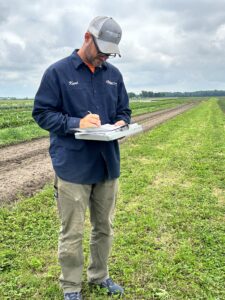
It starts each Thursday, when Farmer Kurt does a “field walk.” He surveys the fields to see which crops will be ready in four days. As he plans, he considers not just what’s abundant, but what will delight and challenge you. (Our goal isn’t just to feed you — it’s to help you eat more vegetables and discover new ones.)
Each box is carefully curated to include a mix of:
-
A root vegetable
-
A leafy green
-
An herb
-
A couple of staples
-
And one “curveball” item to stretch your culinary muscles
Once Kurt builds the proposed box list, he runs it by Corinna. When approved, the list is sent to CSA Coach Cadie Jardin by Thursday night so she can begin working on your weekly recipe content. Corinna also uses it to write her CSA newsletter over the weekend.
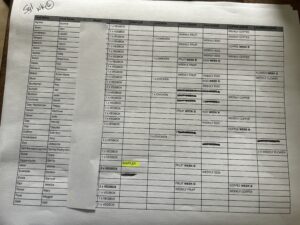
Corinna prints out the CSA site checklists that are used by our site hosts. She counts the number of shares in each column every week. These numbers change based on members switching sites.
Step 2: Building the Checklists
On the weekend, Corinna prints out CSA checklists for each pickup site using a Google Sheet. She manually removes any “Week A” or “Week B” customers (depending on which biweekly share week it is), and tallies up totals for each share type:
-
Veggie shares
-
Fruit shares
-
Egg shares
-
Flower shares
-
And more
All those numbers are transferred onto a Master Checklist that lives in the packing shed.
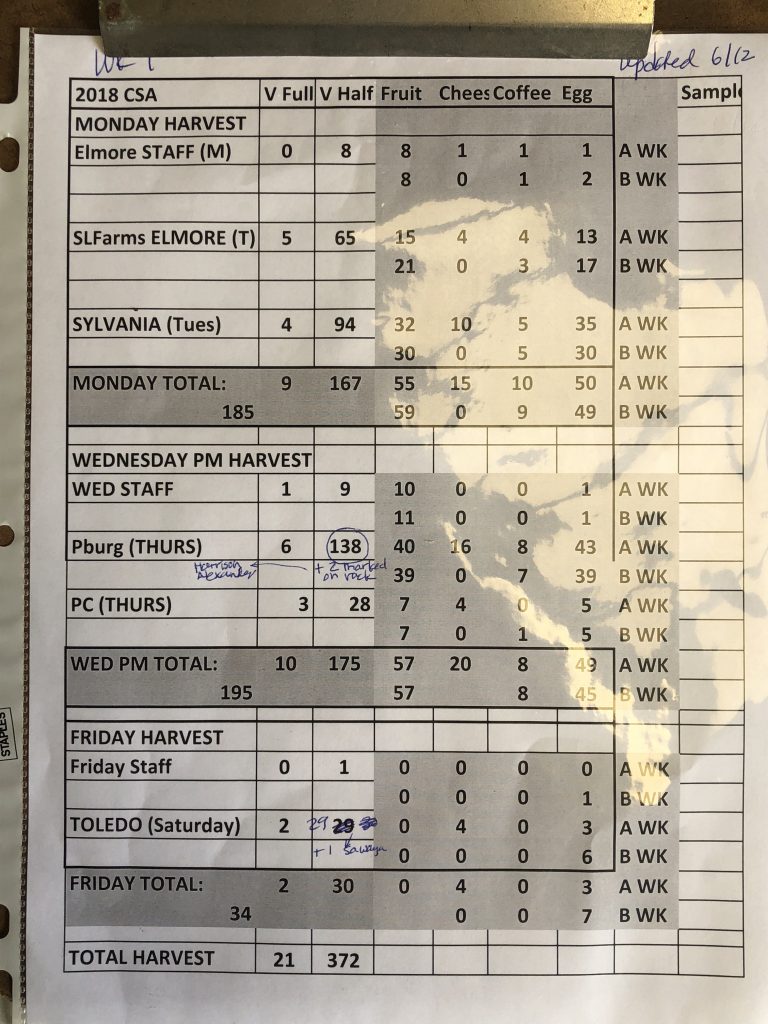
This is the master list showing how many share types to box for each site.
This Master Checklist is used by everyone:
-
Kurt uses it to know how many portions of each crop to harvest per night
-
The bin washers use it to prep the right number of harvest bins
-
The truck loader uses it to prep the correct number of empty bins
-
The pack crew uses it to know how many eggs, cheeses, or special shares to include
Step 3: Harvest Day – The Harvest Board
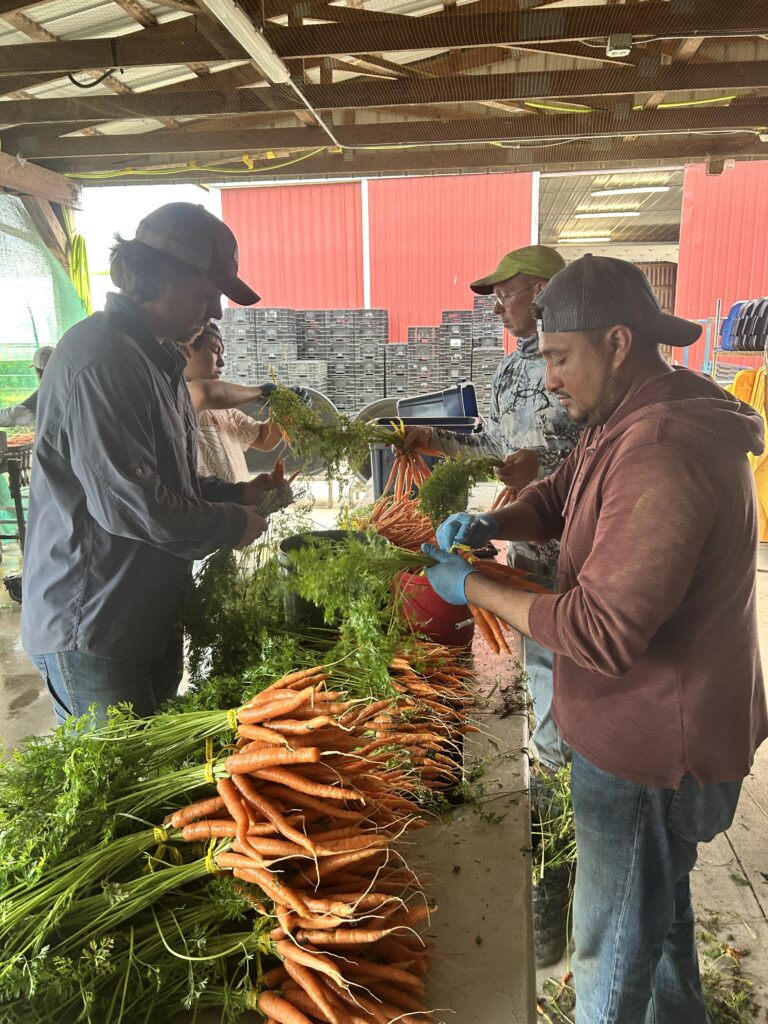
The crew washes and bunches carrots after harvesting Monday for CSA.
On Monday and Wednesday mornings, the production crew (Asuncion, Juan, Jose, Pedro, John, and Noah) arrive early to begin harvesting. Their instructions come from a huge dry-erase board we call the Harvest Board, which Kurt fills out the night before.
For each crop, the Harvest Board lists:
-
The number of portions to harvest (by weight, bunches, or boxes)
-
Field location
-
Which tool to use (knife, clippers, shovel, etc.)
-
Which bin to pack it in
-
Where to store it when harvested
-
Who it’s for (CSA, chefs, store, etc.)
-
How to wash and bundle it
As each crop moves through the process (harvest → wash → cool storage), a green magnet is moved along that row on the board. When the magnet reaches the far right, the crop is officially ready for the CSA box line.
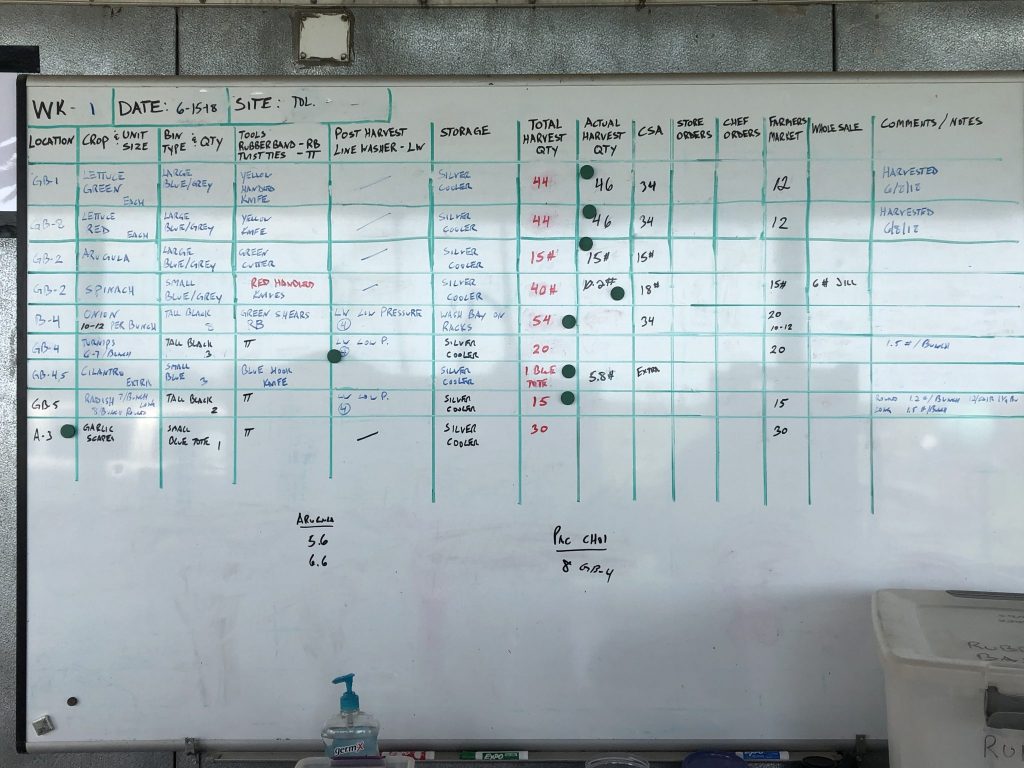
This is the white board we use to help us figure out what to harvest each week.
Step 4: Packing Night – The Packing Board
At 4 PM on Monday and Wednesday evenings, our CSA packing crew arrives to start pre-bagging and boxing the produce. Their tools? A second giant dry-erase board: the Packing Board.
The Packing Board includes:
-
The item packing order (yes, there’s a specific sequence!)
-
Special bagging instructions (e.g., “189 bags of arugula, ¼ lb each”)
-
Add-on share items like fruit, eggs, cheese, or sweet corn
-
A sign-in form for food safety records
-
An error tracker in the bottom corner to record any packing mistakes from the previous week
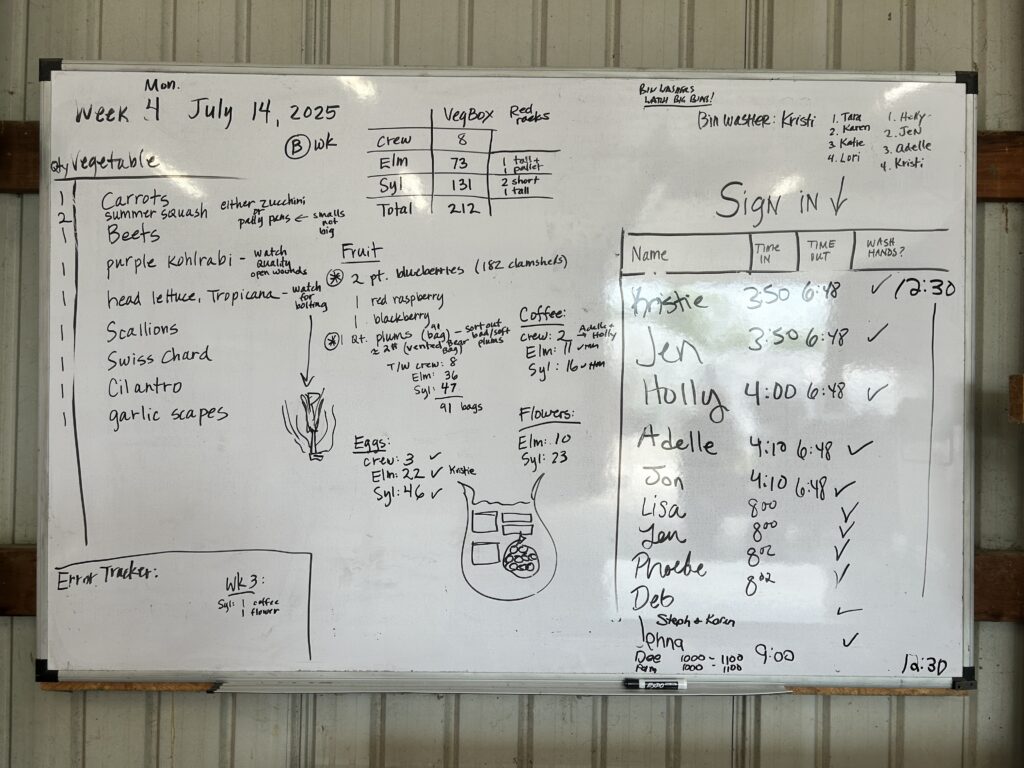
An example of our packing board. Note the error tracker in the bottom left corner, the box content list on the left, and the “crew sign-in” form on the right. All of these are things we are required to document for certifiers.
Once items are prepped and bagged, we set up the packing line: a long table filled with produce bins in precise order. Each CSA bin is placed on a rolling table and moves down the line, where each crew member adds one item in the correct position to create a uniform unboxing experience.
Finished bins are packed into rolling racks we call “the cages” — custom-designed to hold bins securely and make for smooth transport onto the delivery truck.

Lori rolls the CSA bin down the pack line table.
Why Accuracy (and Feedback) Matters
Years ago, one of our biggest mistakes was not packing enough bins! Now we pre-count all empty bins before packing starts. When we run out of bins, we know we’re done.
If we run short on a veggie mid-pack, we pause and harvest more. If a packing error happens (someone’s box misses garlic scapes or a flower share), we record that error on the Packing Board. This creates a feedback loop for our crew — and since tracking began, mistakes have dropped significantly. We now average just 1-2 errors per week out of 400 boxes!
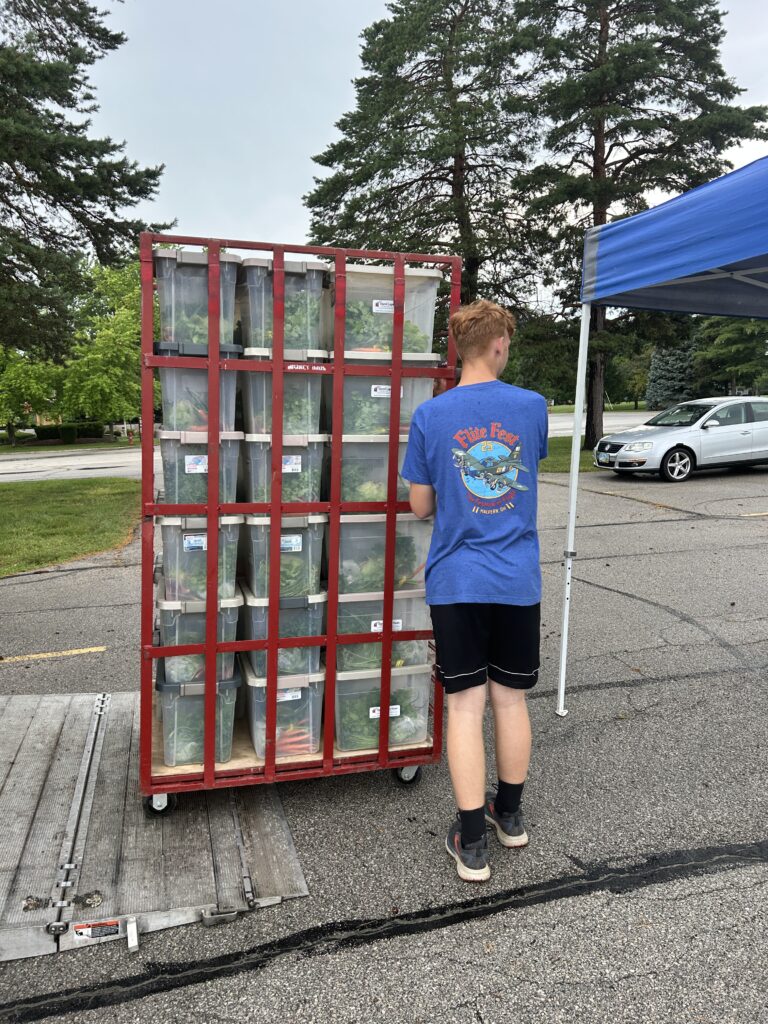
We tuck the CSA totes into these custom designed racks known as “the cage.”
Bonus: Food Safety and Certification Records
The white boards aren’t just for team coordination – they’re also our documentation system. Everything we need for organic certification and food safety audits lives here:
-
Cleaning checklists
-
Crop weights and harvest yields
-
Crew and visitor attendance
- Hand washing documentation
-
Packing Error logs
At the end of each night, we snap a photo of the boards and upload it to our Google Drive for safekeeping.
It’s a Whole Operation… Just to Pack Your Box!
It may look like magic when your CSA box shows up each week filled with clean, beautiful veggies – but behind the scenes, it’s a carefully choreographed process powered by people, systems, and yes… a couple of white boards.
We’ve learned that in order to scale up and serve 400 families, you need a good plan, and a great team. And a really big marker.